
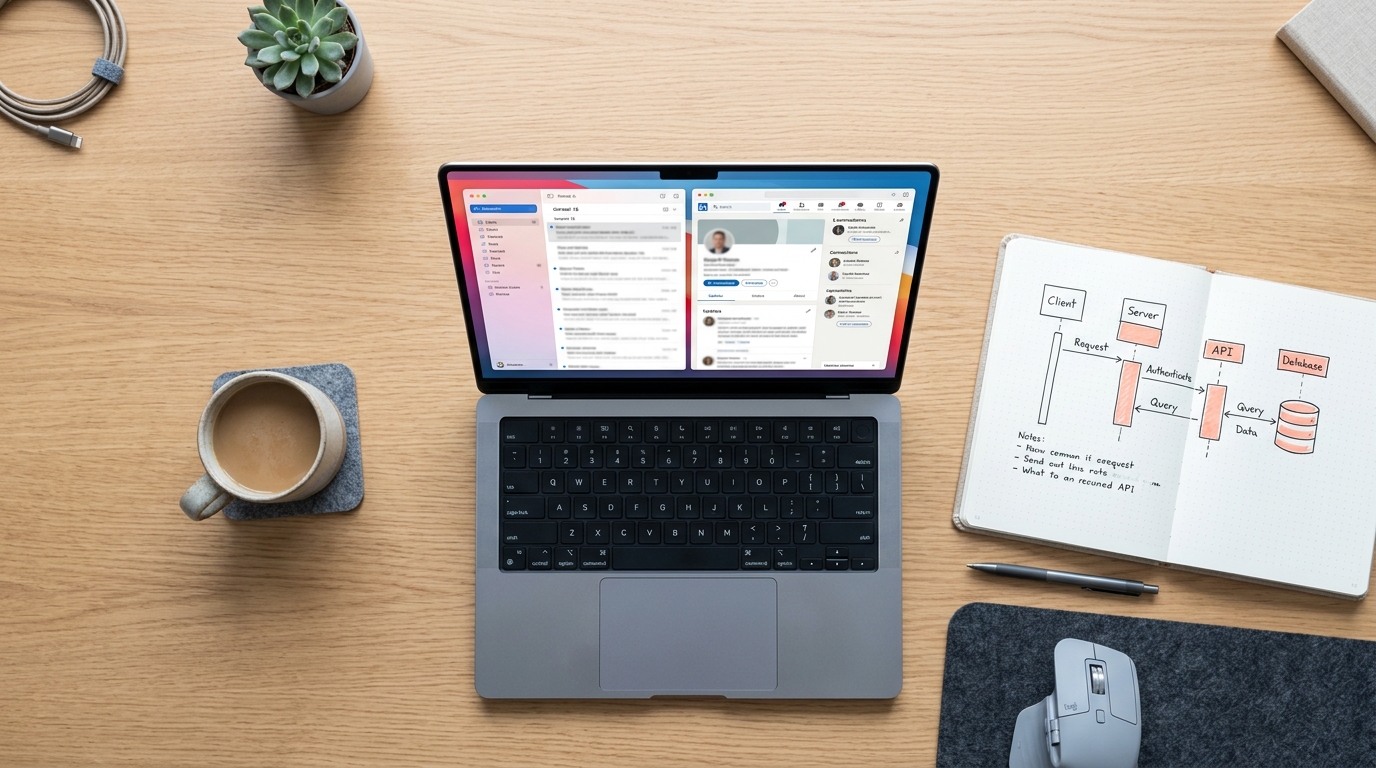
Single-Channel Outreach Is Leaving Replies on the Table
Send five cold emails to someone who never checks that inbox during business hours, and you’ll get silence no matter how good the copy is. Meanwhile, that same person is scrolling LinkedIn every day. The channel, not the message, was the problem, and no amount of subject-line optimization fixes a channel mismatch.
Multichannel outbound isn’t about being everywhere at once, that’s how you become the person who gets blocked. It’s about showing up in two places with one coherent thread, so a prospect who missed you in one inbox catches you in the other. Done right, it feels less like pursuit and more like consistency.
Why This Beats Piling On More Emails
More follow-up emails past a certain point stop feeling persistent and start feeling desperate. I’ve written before about not turning follow-ups into a productivity-vampire situation. A LinkedIn touch does something a fourth email can’t: it reminds someone you’re a real person with a real profile, not just a subject line they’ve started to ignore.
There’s a psychological piece here too. An email that’s gone unanswered twice starts to feel, to the recipient, like a decision they’ve already implicitly made. They didn’t reply, so they’ve filed it as “not now” even if they never consciously decided that. A LinkedIn touch resets that framing without asking them to reverse a decision. It’s a new interaction, not a fourth ask on the same one.
A Sequence That Doesn’t Feel Like a Siege
Day 1: Cold Email
Your best opener, researched and specific, the kind covered in how to craft a cold email that doesn’t feel cold. No LinkedIn touch yet. Give the email room to work on its own; jumping to a second channel too early can read as impatient before you’ve even given the first one a fair shot.
Day 3: LinkedIn Profile View Plus Connection Request (No Note, or a Short One)
Just showing up. If you send a note, keep it under two lines and don’t repeat your email pitch, that’s redundant and a little needy. A profile view alone often does more subconscious work than people expect; most professionals check who’s viewed their profile, and a familiar name showing up there primes the next email to feel less cold.
Day 5: Follow-Up Email
Reference something new, not just “just bumping this up.” A relevant article, a specific insight, a direct question. This is also a good point to reference the LinkedIn connection lightly, if it was accepted. “Thanks for connecting” is a small, natural bridge between channels that doesn’t feel engineered.
Day 8: LinkedIn Comment or Engagement
If they’ve posted anything recently, a genuine, specific comment does more for your visibility than a second connection request. This step requires the most judgment of the whole sequence. A generic “Great post!” comment reads as obviously templated, while a comment that adds a real point or asks a real question reads as someone actually paying attention.
Day 11: Final Email
Direct, low-pressure close. Something like: “Sounds like the timing’s off. I’ll leave it here. If it becomes relevant, my inbox is open.” This isn’t giving up; it’s closing the loop cleanly, which paradoxically gets more late replies than an open-ended sequence that just fades out.
What Makes This Work (And What Breaks It)
Works: Consistency of message across channels, same value proposition, same tone, no channel contradicting another. Spacing that gives each touch room to land instead of stacking up in the same 48 hours. A sequence that has a clear, acknowledged endpoint rather than trailing off indefinitely.
Breaks: Sending a LinkedIn message and a cold email on the same day. Using LinkedIn to repeat your email verbatim. Connecting on LinkedIn and immediately pitching in the request note, that’s the fastest way to get declined and remembered for the wrong reason. Commenting on every single post someone makes, which shifts from “attentive” to “watching too closely” faster than most people realize.
The goal of the LinkedIn touch isn’t to sell. It’s to make the next email recognizable instead of anonymous.
Practical Setup
- Build your email sequence first, in a tool like UseINBOX that lets you schedule and pause steps based on replies.
- Layer LinkedIn touches into the gaps. Most CRMs or a simple spreadsheet reminder works fine at this scale, and you don’t need dedicated software until you’re running this across dozens of prospects a week.
- Keep a shared research note per prospect so your LinkedIn comment and your email reference the same specific detail, not two disconnected observations that make it obvious two different moments of research produced them.
- Track reply rate by channel-combination, not just by email step, so you can see whether the LinkedIn touch is actually lifting response, not just adding noise and extra manual work for no measurable gain.
- Set a hard stop. Decide in advance how many total touches (across both channels) a sequence gets before you move on, and honor it even when you’re tempted to add “just one more.”
Common Questions About Running This
Does connecting on LinkedIn before emailing work better than emailing first? Generally no. A cold connection request with no context often gets ignored or declined at a higher rate than one that follows an email the person at least skimmed. Email first, LinkedIn second tends to outperform the reverse order.
What if they view my LinkedIn but don’t accept the connection? That’s still useful signal. It means the name registered. Let the next email reference something genuinely new rather than pushing a second connection request, which can start to feel like pressure.
How many total touches is too many? Beyond five or six touches across both channels over roughly two weeks, returns drop fast and the risk of feeling like harassment rises faster than the reply rate does. If it hasn’t landed by touch five, a clean close beats a sixth attempt almost every time.
The Bottom Line
Multichannel outreach isn’t a hack for squeezing in more touchpoints. It’s an acknowledgment that people live across more than one inbox, and meeting them where they actually are beats emailing louder into a channel they’ve already tuned out.